Why You Need an AI Harness?
Most of us had our first “AI moment” through a simple chat interface. You typed a question, the model typed back, and for a second, it felt like magic. But that magic had its limits. We all remember the early days when models would confidently hallucinate facts or fail miserably at counting the “r’s” in the word strawberry.
While today’s chat interfaces are much slicker, they can browse the web and use calculators, the underlying engine is still essentially a very sophisticated word predictor. If you’re just chatting, that’s fine. But if you’re trying to build a real-world AI application or run a local model for a specific business use case, “fine” isn’t good enough.
You need something more than just a model. You need a harness.
The Model is Not the Product
The reality is that a raw LLM, on its own, is not a product. It’s non-deterministic, unpredictable, and a bit of a “black box.” To turn that powerful engine into an enterprise-ready tool, you need agentic infrastructure.
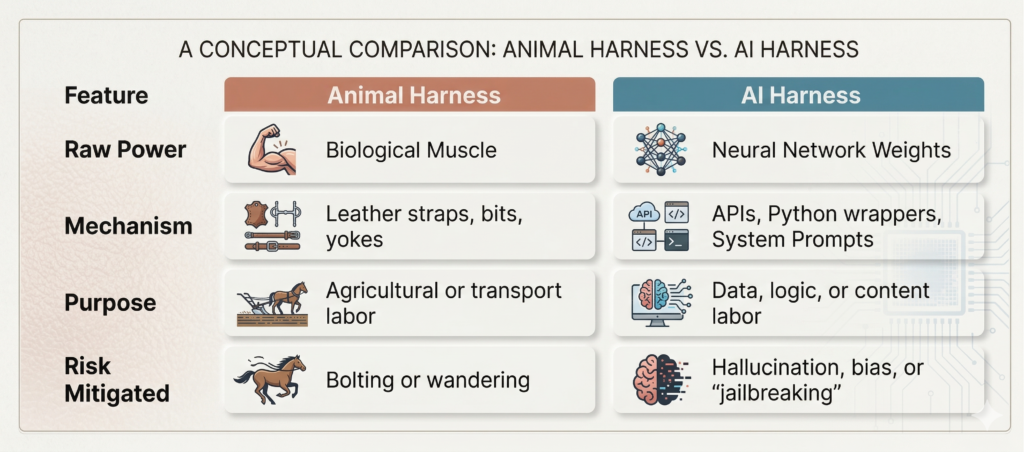
Think of it like this: A horse is a powerful animal, but without a harness, reins, and blinders, it’s just a force of nature. It might bolt, wander, or kick. When you add a harness, you don’t change the horse’s muscles; you change how you direct that power.
An AI harness works the same way. It doesn’t change the model’s “weights” (its brain), but it wraps around the model to manage how it operates, ensuring it stays on the path and performs tasks reliably.
The Four Pillars of an AI Harness
To turn a model into an “agent” that can actually get work done, the harness serves four primary purposes:
- Control and Steering (The Interface)
- The harness is the middleman between the LLM and the real world. It defines how the model reasons, how it loops through a problem (the “Think-Act-Observe” cycle), and how it manages its own state so it doesn’t lose its train of thought.
- Safety and Constraint (The Guardrails)
- This is where you prevent the AI from “bolting.” The harness ensures the model doesn’t execute harmful code, exceed token limits, or leak confidential data.
- Example: If a customer asks a support bot for internal server logs, the harness intercepts that request and says “No,” even if the LLM is tempted to comply.
- Load Distribution (The Optimization)
- For complex workflows, one model isn’t enough. The harness acts as a conductor, distributing tasks across multiple workers.
- Example: A ticketing agent might simultaneously read a support ticket, query historical data for similar issues, and check the team’s current workload. The harness manages these parallel tasks so the ticket is assigned efficiently.
- Integration (The Connection)
- A model in a vacuum can’t do much. The harness connects it to your databases, APIs, and external services. It also handles the “messy” parts of software, like managing API timeouts so the agent doesn’t just crash when a tool is slow to respond.
Designing for the Future
Technology is moving fast. We’re already seeing “co-evolution,” where models are being trained specifically to live inside these harnesses.
To build an effective Agent application, keep these principles in mind:
- Self-Verification: Don’t just take the AI’s first answer. Use the harness to prompt the model to “double-check” its work.
- Tracing: Turn the “black box” into a timeline. You should be able to see if a failure happened because of bad reasoning (logic error) or a broken tool (technical error).
- Disposable Guardrails: Build strict checks today to keep things safe, but keep your architecture flexible. As models get smarter (moving from GPT-4 to GPT-5), they’ll get better at self-correction, and you may be able to remove those “training wheels” later.
A harness isn’t just about fixing today’s bugs. It’s about preparing for how models are evolving. It allows you to stay “model agnostic”, meaning you can swap out your LLM for a newer, cheaper, or faster version next month without rewriting your entire business logic.
In the end, the model provides the intelligence, but the harness provides the results.